

By the Universal U Wellness Team · Last updated 2026-05-25
What Testosterone Is and What "Healthy" Looks Like
Testosterone is the primary male sex hormone, with effects on muscle, bone density, energy, mood, libido, and metabolic function. Total testosterone in adult men typically ranges 300–1,000 ng/dL, with free testosterone (the bioavailable fraction) ranging 9–30 ng/dL. The "healthy range" is wide — what matters more than a single number is the symptom picture and the trend over time.
Testosterone naturally declines about 1% per year after age 30. Some men feel this; some don't. The factors that move it: sleep, body composition, training, stress (cortisol), nutrient status, alcohol intake, and underlying medical conditions.
Vitamin D3 — The Most Replicated Testosterone-Supporting Nutrient
Vitamin D status correlates positively with testosterone levels in adult men. A 2011 RCT in vitamin D-deficient men showed that supplementing 3,332 IU/day for one year increased total testosterone by ~25% [Pilz et al., PubMed]. Subsequent research has reinforced the deficiency-corrects-testosterone story: men deficient in D3 see meaningful repletion benefits; men already replete don't see additional testosterone effects.
What dose, what serum level
Adult men typically benefit from 2,000–4,000 IU/day to maintain serum 25(OH)D at 30–60 ng/mL [NIH Office of Dietary Supplements]. Get your D3 level checked annually — adjust supplementation based on labs.
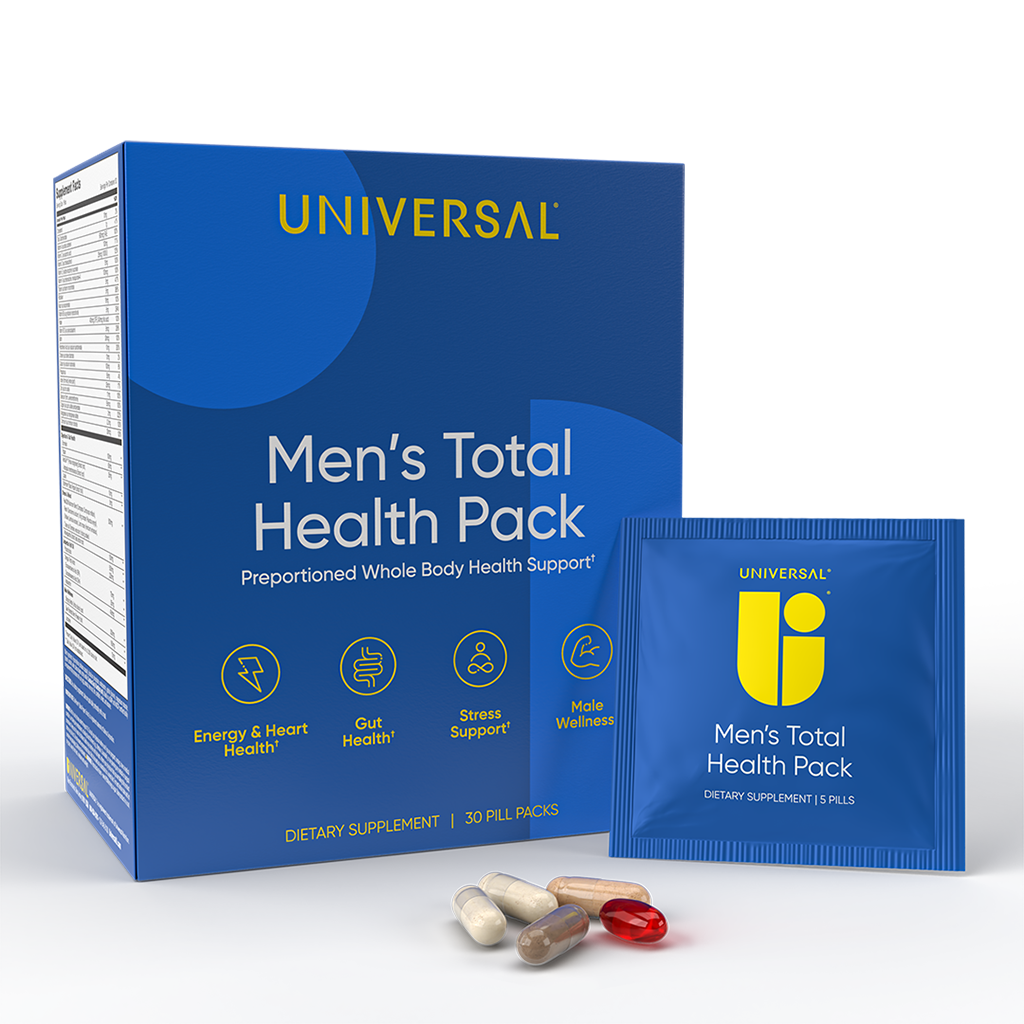
Honest note on Universal U: The Men's Total Health Pack provides 1,000 IU D3 — meets daily value but below the 2,000–4,000 IU range some premium men's brands target. If your D3 is low on labs, supplement additional D3 separately per your doctor's guidance. See the Men's Total Health Pack →
Zinc and Magnesium — The Mineral Foundation
Zinc is required for testosterone synthesis
Zinc-deficient men show measurable testosterone drops; repletion restores normal levels [per Examine.com zinc analysis]. The RDA is 11 mg/day. The Men's Pack provides 15 mg — covering repletion without crossing the 40 mg upper limit (chronic excess zinc suppresses copper absorption).
Magnesium correlates with free testosterone in active men
Magnesium status correlates positively with free testosterone in active men. Mechanism likely involves magnesium's role in sleep depth and stress regulation — both of which affect T production indirectly.
The form matters: magnesium glycinate is well-absorbed and doesn't cause GI urgency. Oxide is poorly absorbed (~4%); citrate sits in the middle.
Honest note on Universal U: The Men's Total Health Pack does NOT contain magnesium. The De-Stress & Sleep product provides 300mg magnesium as oxide (less-bioavailable but functional for sleep). For premium magnesium glycinate as part of your testosterone-support stack, you'd supplement separately.
Ashwagandha — The Stress-Side of the Equation
Chronically elevated cortisol suppresses testosterone production. Ashwagandha (KSM-66 form) has multiple RCTs showing meaningful cortisol reduction — the seminal 2012 Chandrasekhar trial showed a 27% cortisol reduction vs. placebo in chronically stressed adults [PubMed]. Subsequent trials in stressed men have shown testosterone increases of 14–17% in some studies, likely driven by the cortisol-reduction pathway rather than direct testosterone stimulation.
KSM-66 dose and what to expect
Clinical doses range from 300–600mg/day of KSM-66 standardized extract. Expect cortisol and sleep changes within 2–4 weeks; testosterone-related lab changes (if any) by 8–12 weeks.
Honest note on Universal U: The Men's Pack provides 150mg of generic ashwagandha extract (NOT the KSM-66 standardized form used in the cortisol research). KSM-66 is a specific patented full-spectrum extract; the Pack provides foundational ashwagandha at 150mg. For the KSM-66 form specifically at clinical doses (300–600mg/day), supplement separately from a dedicated KSM-66 brand.
What Moves Testosterone More Than Any Supplement
Sleep is the highest-leverage testosterone input
Sleeping 5 hours/night for one week drops testosterone by 10–15% in healthy young men [per a 2011 PubMed study]. Chronic poor sleep is the silent driver of declining testosterone in middle-aged men. 7+ hours of consistent sleep is non-negotiable.
Resistance training and body composition
Lifting heavy compound exercises (squat, deadlift, bench, overhead press, row) elevates testosterone acutely during training and supports baseline testosterone over years. Excess body fat — especially visceral fat — converts testosterone to estradiol via the aromatase enzyme, lowering free testosterone. Body composition matters more than any supplement.
Other lifestyle inputs: limit alcohol to ≤2 drinks/day (chronic alcohol is one of the bigger hidden suppressors), manage stress (chronic cortisol), maintain protein intake, eat enough fat (testosterone is synthesized from cholesterol).
What to Skip — The "Test Booster" Category
Most "test booster" supplements rely on:
Tribulus terrestris — small effect on libido in some studies, no consistent testosterone effect
D-aspartic acid — initial promise, replicated studies showed no effect at supplement doses
Fenugreek — weak evidence; some libido effect but minimal testosterone change
Horny goat weed (icariin) — interesting in-vitro work, minimal human research at supplement doses
Proprietary blends with 10–15 ingredients — can't verify per-ingredient doses
The honest framing: foundational nutrients (D3, zinc, magnesium) + KSM-66 ashwagandha + sleep + training + body composition is what moves the needle. The "natural anabolic" category is mostly marketing.
If your free testosterone is clinically low (below ~9 ng/dL or symptoms despite supplementation), see your doctor for proper evaluation. TRT is a medical intervention with its own considerations — it's not a "supplement" decision.