

By the Universal U Wellness Team · Last updated 2026-05-25
What's Different About Adult Men's Nutrient Needs
After 30, three things start to shift: vitamin D status often drops (more indoor work, less unprotected sun), recovery from training takes longer (magnesium and omega-3 matter more), testosterone begins its gradual decline (~1% per year, with cortisol management mattering more), and the slow-build cardiovascular and prostate risk-factors start to show up on bloodwork. A men's multivitamin that ignores these isn't doing its job.
The Six Things Your Multivitamin Should Have
Vitamin D3 at 2,000–4,000 IU
The historical "400 IU is enough" RDA was set in the 1990s for skeletal-disease prevention. Current evidence supports 2,000–4,000 IU/day to maintain optimal serum 25(OH)D (30–60 ng/mL range), with downstream benefits for testosterone, mood, and immune function [NIH Office of Dietary Supplements].
Honest note on Universal U: The Men's Total Health Pack provides 1,000 IU D3 — meets the daily value but below the 2,000–4,000 IU range some premium men's brands target. Get your serum 25(OH)D checked annually. If labs show D3 below 30 ng/mL, supplement additional D3 separately per your doctor's guidance.
Methylated B-Vitamins (Methylcobalamin B12 + L-Methylfolate)
About 40% of men carry MTHFR variants that reduce synthetic folic acid conversion. Methylcobalamin B12 and L-methylfolate work for these men in ways the cheaper synthetic forms don't. Look for both on the label.
Magnesium Glycinate (Not Oxide)
Magnesium oxide is cheap but ~4% bioavailable. Magnesium glycinate (30%+ bioavailable) supports muscle recovery, sleep, stress, and training output. Most adult men under-consume magnesium.
Honest note on Universal U: The Men's Total Health Pack does NOT contain magnesium. For supplemental magnesium, the De-Stress & Sleep formula provides 300mg as magnesium oxide (less-bioavailable form, but functional for sleep + relaxation). For premium magnesium glycinate in your daily multi, you'd need to supplement separately or choose a different brand.
Zinc at 15 mg (and NOT More)
Zinc supports testosterone synthesis and immune function. The RDA is 11 mg; 15 mg in a daily multi covers most active men without crossing the 40 mg tolerable upper limit (which can suppress copper absorption over time). Look for the "less is enough" approach.
An Adaptogen — KSM-66 Ashwagandha
Cortisol management is one of the highest-leverage moves for adult men. KSM-66 ashwagandha at 300–600mg has multiple RCTs showing meaningful cortisol reduction [Chandrasekhar 2012, PubMed]. Lower cortisol → better sleep, better recovery, better testosterone-to-cortisol ratio.
Honest note on Universal U: The Men's Total Health Pack provides 150mg of generic ashwagandha extract (NOT the KSM-66 standardized form). KSM-66 is the specific patented full-spectrum extract used in most published clinical research, including the 2012 Chandrasekhar cortisol RCT. The Pack provides foundational ashwagandha support at 150mg; for the KSM-66 form specifically at clinical-trial doses (300–600mg/day), supplement separately from a dedicated KSM-66 brand.
Saw Palmetto + Lycopene + Stinging Nettle for Prostate Support
After 30, prostate health enters the conversation. Saw palmetto at 320mg has clinical research for BPH symptom support [Mayo Clinic]. Lycopene provides prostate-specific antioxidant support. Stinging Nettle Root is often paired with saw palmetto in European phytotherapy for BPH.
Universal U's Men's Pack provides: Saw Palmetto 160mg (half the typical clinical-trial dose — foundational support, not treatment-grade), Lycopene 10mg, and Stinging Nettle Root 200mg. If you have diagnosed BPH, your urologist may recommend a higher saw palmetto dose; the Pack is a foundation, not a treatment-grade prostate stack.
What to Avoid in a Men's Multivitamin
Iron — Adult men don't lose iron monthly and shouldn't supplement unless their doctor confirms a deficiency. Iron buildup is a real concern.
Proprietary blends — If you can't see the per-ingredient dose, you can't verify what you're taking. Avoid.
Folic acid (synthetic) instead of L-methylfolate — Cheaper, but doesn't work for the ~40% of men with MTHFR variants.
Magnesium oxide — Cheap, mostly unabsorbed. If magnesium is in the formula, it should be glycinate, citrate, or malate.
"Testosterone boosters" with herbs and proprietary blends — Most over-promise and rely on the placebo effect. Stick with the evidence-backed ingredients (D3, zinc, magnesium, ashwagandha).
Sub-effective doses — Vitamin D3 at 400 IU. Magnesium at 50 mg. Zinc at 5 mg. These doses meet the historical RDA but don't deliver the clinical effect you're paying for.
Multivitamin vs. Daily Pack — The Convenience Difference
A traditional multivitamin is one pill (or two) covering 12–25 ingredients. A daily pack is a pre-portioned sachet containing multiple smaller pills/capsules — typically because the formula includes things that can't all fit in a single tablet (omega-3 softgels, larger-dose herbs, separated minerals that interact when combined).
Why daily packs make sense once a multivitamin gets serious
A single-tablet multivitamin literally cannot fit therapeutic doses of D3 + magnesium glycinate + KSM-66 ashwagandha + saw palmetto + krill oil omegas in one pill. The "men's one-a-day" format is what forces the under-dosing you see at the drugstore. Daily packs solve this by using multiple capsules per sachet.
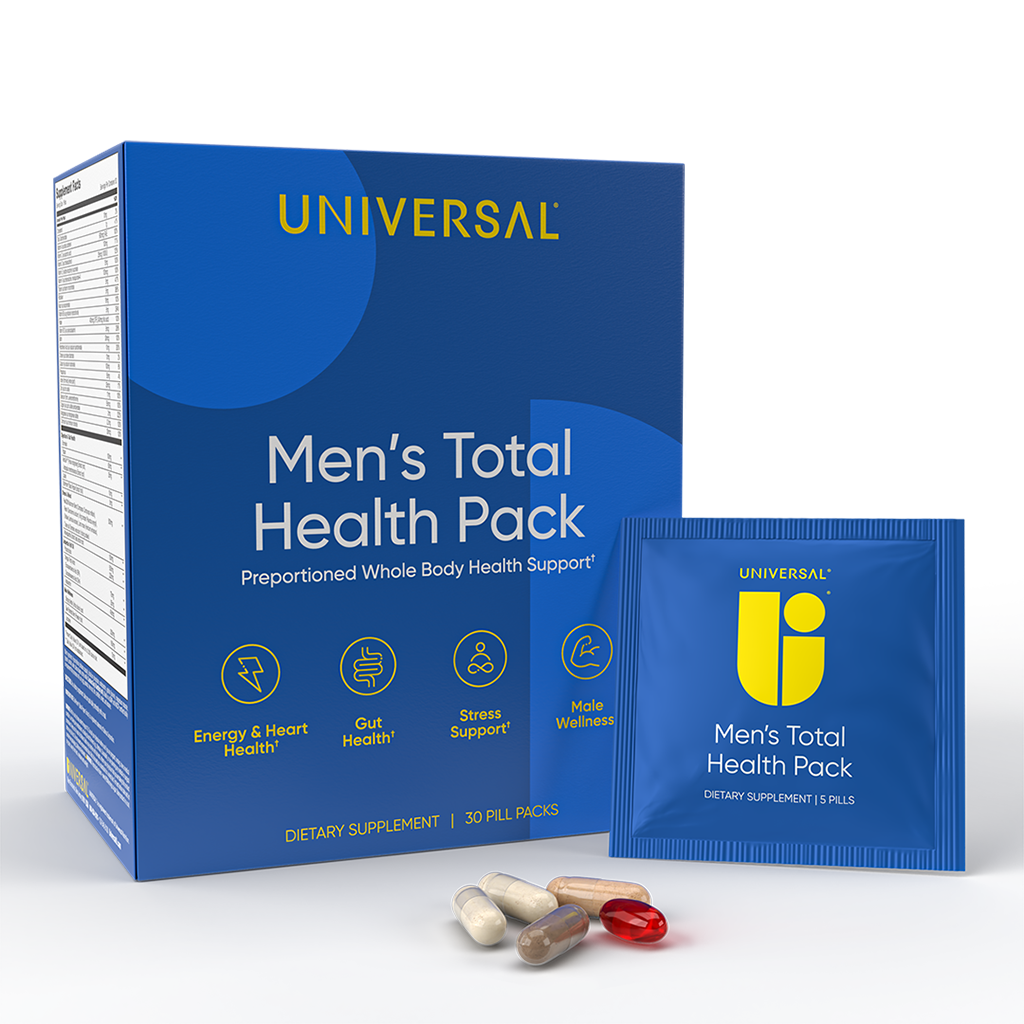
The Universal U Men's Total Health Pack uses this approach — 22 nutrients at therapeutic doses in one pre-portioned daily sachet. See the Men's Total Health Pack →
What to Stack With It
A men's multi is the foundation. Three high-leverage add-ons by use case:
Daily, regardless of training
Creatine — 5 g/day, any time. One of the most-studied supplements ever; benefits both strength and cognition. Any reputable creatine monohydrate from a third-party tested brand works (Bulk Supplements, Optimum Nutrition, Thorne, NOW Foods). Universal U doesn't currently sell creatine on DTC.
Training days
A moderate-caffeine pre-workout (100mg caffeine + beta-alanine + L-citrulline + L-tyrosine works well for most adults) from a third-party tested brand. Post-workout: electrolytes and hydration (sodium-heavy electrolyte products for shorter sessions; full EAA + BCAA + electrolyte recovery powders for sessions over 60 minutes). Universal U currently focuses on the daily-multivitamin pill-pack layer; pre-workout and electrolyte products are sourced from your preferred brand.
High-stress nights
De-Stress & Sleep 60–90 minutes before bed — additional L-theanine, ashwagandha, magnesium, lemon balm. Try De-Stress & Sleep →